

Published in the February 8 – 21, 2017 issue of Gilroy Life
By Marty Cheek

Marty Cheek
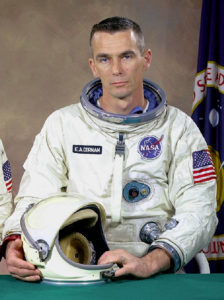
Eugene Cernan
In a time when America’s most ambitious project is to build a wall to divide nations, it’s sad we lack the leadership to unite us around a big and bold adventure as we did half a century ago. For one brief shining moment, we shared in the Camelot administration of President John F. Kennedy a government that joined all Americans — and all humanity — on exciting epic journeys to the Moon.
I was a toddler when Neil and Buzz set their one-giant-leap-for-mankind bootprints on the dust of Earth’s companion world in July 1969.
The only Moon mission I remember was Apollo 17, with Commander Eugene Cernan and Lunar Module Pilot Harrison Schmitt spending three days in the Taurus-Littrow valley taking rock and dust samples and setting up scientific equipment.
That was in December 1972 when I was attending the Methodist Nursery School in Hollister. In front of a tiny black-and-white TV, I sat transfixed with other nursery schoolers watching the two astronauts driving around on their Lunar Rover around mountains and craters.
Mrs. Stevenson, the woman in charge of the nursery school, asked the children to draw pictures of what they wanted to be when they grew up.
Of course, I drew a Saturn V rocket with a waving astronaut standing by it. It was a time when little boys as well as the American nation dreamed big.
Years later in July 1994, I met Cernan at the Huntsville, Ala.-based U.S. Space & Rocket Museum during a celebration of the first manned landing on the Moon.
A modest gentleman, he talked in our short conversation about the importance of science and the need in the human spirit to explore, to take a risk and seek the unknown regions of the universe.
He had been introduced at the event as “the last man on the Moon.” I mentioned to him it sounded like an ominous title, that somehow Americans had given up on lunar dreams. Was Apollo a one-shot deal?
Cernan told me he hoped some young boy or girl somewhere in the world might be in school at that moment with dreams of going back to the Moon one day — this time to stay.
We talked about how Apollo, as well as the previous orbital space missions of Mercury and Gemini, had shined a light on the best in America.They proved that, through the medium of television, we could all voyage to another world together in the pursuit of knowledge and in the spirit of peace.
That time in American history held the violence of Vietnam and the corruption of Richard Nixon. Apollo, however, held for all the world a promise for a brighter future awaiting all mankind.
Congress canceled the Apollo program and further Moon adventures ended. After that shining success, we’ve had presidential leaders talk in wishy ways about going back to the Moon or even going beyond with a trip of millions of miles to Mars.
But the times are different now. We went to the Moon because we faced the Cold War’s anxiety of nuclear annihilation. We were inspired by Kennedy to show the Soviets that American democracy, capitalism and intelligence could accomplish great things not just for a nation but for the whole world. Great ambitions make a great country, we told ourselves back then.
So now our national moonshot project is a massive wall to protect us Americans, or at least our jobs, from Mexican immigrants. If that’s what we really want, we can make it happen.
But with the Jan. 16 death of Eugene Cernan, I wonder if there might be a more ambitious option for us as Americans to unite behind a costly project. Maybe it’s indeed time to go back to the Moon. Maybe this time we can join with Russian, Chinese, Indian, Japanese, African and Mexican engineers and scientists to build a lunar exploration base that would unite the people of the world.
The night of Nov. 8 as the election results came in, I took a get-some-fresh-air walk to the top of the downtown Morgan Hill garage. The Moon hung overhead. I snapped a few photos and thought that, for one brief shining moment, we were at our best when we united to explore our sister world.
Somehow, we Americans forgot how to dream big as a nation — and it’s tragic how that lack of a shared vision has divided us as a people.
I leave the last words of this column to Cernan, quoting the last words the last Apollo astronaut on the Moon said as he left:
“As I take man’s last step from the surface, back home for some time to come (but we believe not too long into the future), I’d like to just say what I believe history will record: that America’s challenge of today has forged man’s destiny of tomorrow. And, as we leave the Moon at Taurus-Littrow, we leave as we came and, God willing, as we shall return: with peace and hope for all mankind.”


