

The $150,000 for decorative aspects was all raised from individuals, businesses and nonprofit organizations
Published in the May 31 – June 13, 2017 issue of Gilroy Life
By Marty Cheek
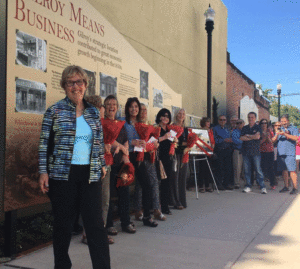
Photo by Dan Harney — Joan Buchanan, front, and volunteers pose inside the recently opened downtown Historic Paseo.
When people stroll through the Gilroy’s new Paseo, they are not just taking a short jaunt between the main downtown business area to Gourmet Alley and the parking lot behind local stores. They’re taking a journey through the town’s colorful history.
Local citizens and dignitaries met at the Gilroy Historic Paseo May 20 to make speeches, cut a ribbon and celebrate the latest addition to downtown’s revitalization.
A community partnership of private and public funding made it happen. Under the direction of award-winning landscape architect Karen Aitken, the Paseo will warmly welcome tourists and residents alike and educate them with a series of seven signs about the city’s past as well as benches to rest and flowers to enjoy.
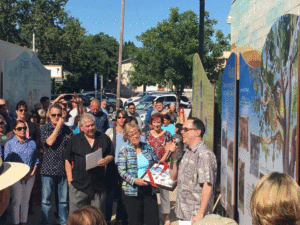
Photo by Dan Harney Executive Director of the Gilroy Center for the Arts Kevin Heath speaks to an assembled group of volunteers and residents at the ribbon cutting for the new downtown Historic Paseo that connects a parking lot with downtown businesses. The idea came from former mayor Al Pinheiro (center, holding papers).
The project started in 2012 when the city of Gilroy purchased a structurally-unsound un-reinforced masonry building from the Gaeta Family. The structure was demolished for public safety reasons and a wide sidewalk, lighting and electrical line were installed in the empty lot.
Al Pinheiro, then the mayor, decided that instead of having an unattractive passageway that was not very welcoming to tourists and downtown shoppers, the Paseo could be transformed into something far more inviting, said Joan Buchanan, who helped lead the installation of the Paseo project. A citizens committee was formed to see what could be done to improve the look and feel of the walkway.
“It was Al’s vision when he left office as a mayor that he wanted to get two downtown paseos, one for the history of Gilroy and one to show the information about our sister cities. And he wanted to make that part of the reason for having these connectors,” she said. “So he called a meeting of about 15 people representing the various organizations in town from the Rotary Club to the downtown association to the Gilroy Historical Society — just everybody who wanted to contribute.”
Pinherio started off as the project’s official chairman, but Buchanan soon found herself holding the reigns.
“At the last minute, he pulled a little fast one and put my name on top,” she said with a laugh. “He had the vision and I had the time to implement it. It was fun.”
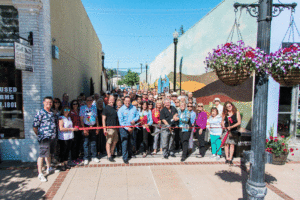 Most of the research work for the seven history panels that serve as a gauntlet for pedestrians going through the Paseo was done by the historical society in 2013 and 2014. The manufacturing was done by two companies — iZone in Texas did the panels and the metal work was done by Nuno Iron in King City, Buchanan said. All the landscaping was done by GB Landscaping, a company in Gilroy owned by Greg Bozzo. Local artist Whitney Pintello painted a serene landscape of the golden hills of Gilroy as a background on the two walls of the buildings on both sides of the passageway.
The decorative aspects of the Paseo was completed for less than $150,000, the money all raised from individuals, businesses and nonprofit organizations that believe in the revitalization of downtown Gilroy, Buchanan said. The major sponsors were Recology, Pinnacle Bank, the Rotary Club of Gilroy, the Gilroy Arts Alliance, Headstart Nursery, Jack and Carol Peters, the Gilroy Downtown Business Association, Habing Funeral Home, R.J Dyer Family, Christopher Ranch and the Gilroy Chamber of Commerce. Headstart Nursery also donated hundreds of flower plants to make the Historic Paseo extra colorful.
Donors who contributed $250 each to the project got their names or names of loved ones on nearly 250 bricks installed in the walkway. About 25 more bricks are still available for purchase for last-minute sponsors, Buchanan said. People interested in buying a sponsor brick for the Paseo can apply for one by going to www.gilroyfoundation.org/paseo.
“Like all our major events in Gilroy, our citizens our very generous,” she said. “Our companies are very generous and our individuals are very generous. It gives you a good feeling that everyone likes to participate, and we hope to keep the ball rolling with good projects.”
The focus of the Paseo are the seven large-sized panels which use photos, illustrations and text to convey to visitors the narrative of how Gilroy grew into the vibrant South Valley community it is today.
“Once the city was finished with its part of tearing down the building, we got involved in figuring out a way to do the history,” Buchanan said. “It got a little more elaborate than what we anticipated but we wanted to do it in a way where the panels could be replaced in the future if they are damaged. So there are permanent frames that hold those panels up. But the panels can be duplicated and replaced, so that was part of why we got such an elaborate system there.”
The journey through history that pedestrians go through when visiting the Paseo includes a story of the many immigrants and citizens who helped shape Gilroy. The panels highlight the achievements of the Native Americans, as well as the European, Chinese and Hispanic settlers who were the pioneers and leaders of commerce in the agricultural industry and the public life of the town. And, of course, the rise to glory of garlic in Gilroy’s community culture gets a place of pride on a panel dealing with local farming and ranching history.
Buchanan expects fourth-grade classes from local schools will make a stop at the Paseo when they do their local history curriculum activities at the Gilroy History Museum a few blocks nearby. New residents who are making their homes in Gilroy can also develop civic pride in their community. The panels also add a welcoming experience for tourists visiting Gilroy and seeing how the town formed over the decades, Buchanan said.
“I think it’s part of the puzzle, all of these pieces fit together. You have to get your buildings cleaned up. Nice things attract businesses,” she said. “It was a three-part goal — it was the access to parking, it was education and it was tourism. We noticed so many people would come downtown and take pictures of the big (Gilroy garlic industry) mural in downtown.”
The May 20 ribbon-cutting ceremony brought out many local people who participated in the Paseo project as well as those who feel proud of Gilroy’s history, Buchanan said.
“We had a really nice time,” she said. “The purpose was to really thank our sponsors and the committee people who really worked hard for the last few years. The sponsors were the heart of the project’s success, trying to raise the money to fund all of this. I was very pleased.”


