

Immigration issues raised at Gilroy’s 5th annual event for civil rights leader
Published in the April 19 – May 2, 2017 issue of Gilroy Life
By Marty Cheek
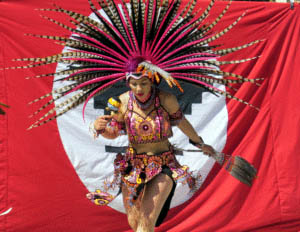
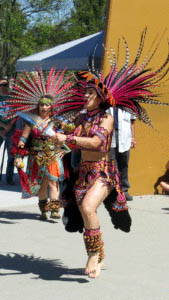
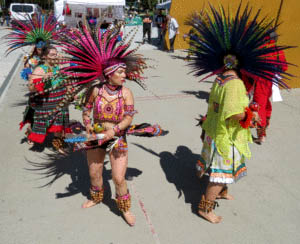
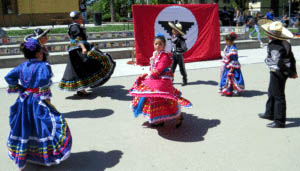
Photo by Marty Cheek An Aztec dancer performs during the April 1 Cesar Chavez celebration.
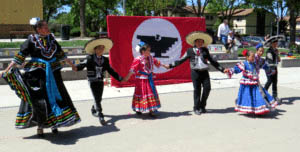
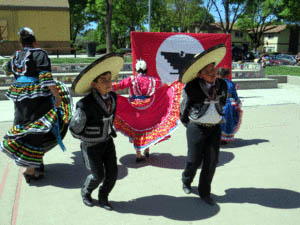
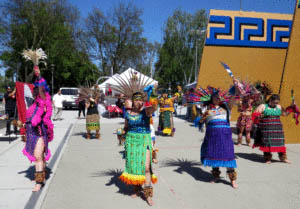
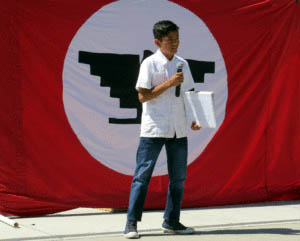
At age 12, Edwin Lopez resembles a young version of the civil rights leader Cesar Chavez. The boy participated at an April 1 celebration of his hero’s life where Morgan Hill and Gilroy residents came together at San Ysidro Park for an afternoon of mariachi music, Aztec dancing and other entertainment. In front of a crowd of about 120 people, Lopez read in Spanish a speech dedicated to Chavez.
“It was about his history and his life and how we should stay together in times of need,” said the South Valley Middle School sixth-grader. “My dad is a worker in the fields, and the first time I learned about Cesar Chavez I learned a lot about the migrant workers.”
In February, Lopez stood with about 200 other people in a peaceful demonstration at the U.S. Immigration and Customs Enforcement agency office in Morgan Hill to protest recent federal immigration policies.
 “It’s important for me because my parents aren’t citizens and there’s a lot of mistreatment and misunderstanding about them,” he said. “So a lot of people are just treated differently than others, and I say it’s not fair, it’s not right.”
Reflecting on what Chavez might tell him, Lopez hopes to one day go to college and become a lawyer who works on immigration issues.
“I think he’d say we should stay united because we’re all humans here and we’re not different people,” he said.
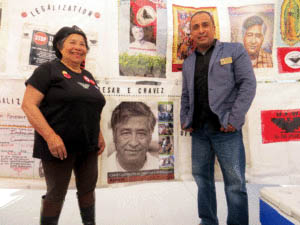
 The fifth annual Cesar Chavez Day Celebration was co-sponsored by the city of Gilroy’s recreation department, the Cesar Chavez Foundation and the Community Agency for Resources, Advocacy and Services. Various nonprofit organizations set up tables at the event to promote their services and involvement in the South Valley community. Under a CARAS pop-up tent sat Gilroy City Councilmember Fred Tovar with 74-year-old Gilroy resident Ruth Martinez. In the 1960s and 1970s the woman served as a nurse for Chavez and other United Farm Worker union members involved in California civil rights protests.
“I use to go on the marches with him and take care of the blistered feet and people who passed out and everything,” Martinez said. “The spirit of the marches was beautiful. It was very inspiring because so many people would learn about the work the farm workers did.”
She showed Morgan Hill resident Matt Kennedy an image of Josefina Flores on her phone. Flores had served as a cook in the UFW movement. She had been hit by seven bullets shot by a farmer when the farm workers went on the famous grape strike in the San Joaquin Valley town of Delano.
 “They removed five of the bullets. She’s still got two of them,” Martinez told Kennedy. “She’s more than 80 now. I met her when I was 16 and we were together throughout the boycotts.”
Chavez had his own life threatened many times during the strikes and union organizing efforts. He knew the Santa Clara County region well. After serving in the U.S. Navy, he married and moved to the East San Jose barrio of Sal Si Puedes (which translates to “get out if you can”) where he and his wife raised eight children. He protested one year at the Gilroy Garlic Festival. And he organized farmers in San Benito County to strike for better working conditions in the 1970s and early 1980s.
 Martinez recalled Chavez’s personality during a time now part of a sometimes forgotten chapter of American history.
“He was the kindest man you would ever want to meet, but you wouldn’t want to make him mad because you couldn’t stand him when he got mad,” she said.
Martinez became a nurse because of him. As a teenager she helped the farm workers striking in Delano and she told him her dream for a career.
“I commented to (Chavez), ‘I always wanted to be a nurse,’ and he asked, ‘Why aren’t you?’ and I said, ‘I can’t.’ You never told Cesar that. He said you can be anything you want to be.” She continued. “Cesar got me into a nursing course, and I became a nursing assistant. And then I became a first-aid (provider) and then I became a nurse.”
She described the UFW motto that he emphasized to her in pushing her toward her vocation. “Si Se Puede. Yes. We. Can.”
 Chavez was born March 31, 1927 in Yuma, Ariz. He died April 23, 1993 in San Luis, Ariz. The message he gave Americans is just as important now as it was when he was alive, Martinez said.
“He was so much for nonviolence, but yet he wanted to get things done. I think it’s important to keep his legacy alive,” she said. “He was like our Gandhi.”
She remembered working in the fields in the 1960s when there were no bathrooms or water for the workers’ comfort. “He put bathrooms and water in the fields. I remember putting water in the gallon milk cartons and put them in the freezer at night, and then in the daytime we’d drink cold water.”
The celebration of Chavez’s birthday was especially important for today’s young people to give them a sense of history, she said.
 “We need to share the story so there can be more improvements,” she said. “I was 16 when I first started marching with Chavez. I’m 74 now. These are the leaders of tomorrow. They’re the ones who are going to get more laws and rights passed for things like UFW.”
Tovar sitting next to her agreed with the sentiment. He hopes the event gives inspiration to up-and-coming Latino leadership for Gilroy and California.
“You see here our future,” he said. “Both my parents were farm workers and they worked with Cesar very closely. And so growing up, myself and my brothers both worked in the fields as well. And to see the changes that have been made, I think it’s important to continue the legacy by reminding our community.”
 Despite the civil rights leader’s impact on many local people’s lives, Tovar believes Chavez’s name is not recognized in schools as much as it should. The Rev. Martin Luther King, Jr. received much attention during the turbulent times of the 1960s, laying down a path for Chavez to unite farm workers for the benefit of their own communities, he said.
“I think it’s time Americans know who Cesar Chavez is because he had so much history here,” he said. “I think little by little, this will be a celebration that our entire community can participate in.”
Creating a Cesar Chavez Day celebration open to everyone helps to educate Latinos and non-Latinos alike on the issues of civil rights that still resonate today, said Reymundo Armendariz, CARAS program director.
 “CARAS started as an organization in 2011 with the purpose to make sure we advocate for Latinos in South Valley, whether that be Gilroy, Morgan Hill or San Martin,” he said. “We thought that part of our mission was to use our culture to mediate that relationship with the non-Latino community. If you look at the police blotter in the newspaper or watch the 11 o’clock news, sometimes the only depiction you get of the Latino community is when someone has committed a crime.”
The nonprofit decided the best way to counter-act that image is to use cultural celebrations not only as educational but also as a way to interact with other people so they can learn what the Latino community is mostly comprised of — everyday, working-class people, he said.
Even in the local Latino community, many people do not understand who Cesar Chavez was and the philosophy he represented and what he dedicated his life to, Armendariz said.
“We thought it was important we use this as an educational opportunity — especially in South Valley, which is still an agricultural-based economy,” he said.


