
In the very heart of the church is the very spirit of our community.


By Kat Teraji
Kat Teraji
Just imagine, before Gilroy became a city, before the Civil War started, a group of 13 people formed the first church of any denomination organized in our area, The Methodist Episcopal Church, South, on June 4, 1853. And that congregation is still here.
On June 4 the Gilroy United Methodist Church (as it is now called) will celebrate its 170th birthday. It’s a part of Gilroy’s rich history.
The congregation first met in a member’s home, in what was known as Pleasant Valley at the time. Their pastor, J.C. Cox, traveled by horseback. When they could afford their first church building, the trustees report for 1855 reads, “During the year they have built a good house of worship estimated to cost $1,000.” It was described as 20 by 40 feet in size, “a frame building painted inside and out, with good seats.” They bought furniture ($37.50) and a carriage for the pastor. In 1862, they constructed a stable ($32).
The early church rolls read like a who’s who of local street names: the Rea, Holsclaw, Dowdy, Eigleberry, Hanna, and Rucker families were members of the church. Dr. H. R. Chesbro was president of the board of trustees.
Another branch of the Methodist Church began meeting in Gilroy in 1857 and became known as the “north” Methodist Episcopal Church. After the Civil War, a new spirit of unity prevailed, and the south church’s smaller building was physically moved and added onto the larger north Methodist Episcopal Church building.
These early Methodists looked for ways to aid those who lived on the margins of society, just as today’s Methodists continue to do. They supported the Freedmen’s Aid Society, organized to help African Americans. They welcomed Chinese Methodist church members from the seed fields of San Juan at the turn of the 20th century, and formed a Japanese Sunday school in 1910. When the 1918 worldwide influenza pandemic swept through Gilroy in the fall of 1919, the expanded Methodist Church became a hospital filled with Japanese patients. The furnace had to be kept going night and day. Dr. Okawa from San Francisco split his time between Watsonville and Gilroy. Sometimes the exhausted doctor collapsed and slept in the pastor’s study.
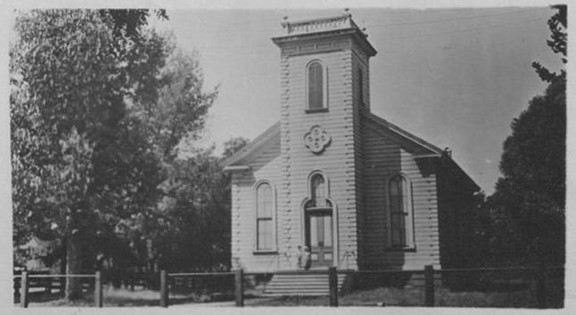
Photo courtesy Kat Teraji Gilroy’s Methodist Episcopal Church, South, the first Methodist Church in Gilroy, founded as a congregation in 1853. This was the first church of any denomination formed in Gilroy, which at that time was known as “Pleasant Valley.”
However, on Sunday morning, Nov. 13, 1938, the furnace exploded, and fire quickly destroyed the grand building that stood as a symbol of unification in Gilroy. Two thousand people watched helplessly as the walls of the church crumpled to the ground. Volunteer firefighter Russell M. Heck, 36, co-owner of the “Busy Bee” tavern on Monterey Street, lost his life.
Surprisingly, there were no thoughts of calling it quits. Rather, a serious determination rose in church members’ hearts as they said, “We shall build again.” They spent weeks digging out the ruin of the old buildings as soon as the embers cooled.
In his journal, the pastor of the church at the time, Rev. Ezelle Cox, described the process of rebuilding the church with all volunteer labor: “On a rainy day, the foundation was laid out. John Wentworth and Roger and Gene did the grading. Delbert and his truck were on the job to finish the excavating. William Radtke loaned his big mixer and a big crew started off the actual building.”
Creative church members sold rusty nails taken from the demolished building that were placed inside little pamphlets showing the drawing of the future church on the front.
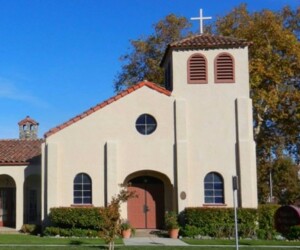
Photo courtesy Kat Teraji The current Gilroy United Methodist Church building at the corner of 4th & Church streets, where it has stood for 84 years (the same location as the 1872 building).
The pamphlet read: “For eight and sixty years, without reward, I’ve faithfully served in the House of the Lord; Please give for me a Quarter—OR MORE, and I will thankfully rest within your door.”
Response from every corner of Gilroy was tremendous, and the church was rebuilt and completely paid for in just a little more than six months, a testament to the Gilroy record of wonderful cooperation in working together, backed by a united, hardworking and courageous congregation and community spirit.
The June 19, 1939 issue of the San Jose Mercury Herald described the dedication of the new building that had risen from the ashes: “It was not so much the beauty of the dignified, simple service so much as the evidence of wonderful, whole-hearted cooperation on the part of pastors, people and the community which had made it possible …”
As we celebrate the 170th birthday of the Gilroy United Methodist Church, the legacy of these fine people in our city’s history lives on in so many ways today in the very walls of the church, in the very heart of the church, and in the very spirit of our community.
Kat Teraji is a recent double cancer survivor, has written articles for various newspapers and publications since 2001, and serves on the board of trustees and as treasurer for the Gilroy United Methodist Church. She wrote this column for Gilroy Life.