

South Valley nonprofits distribute food to help alleviate daily struggle
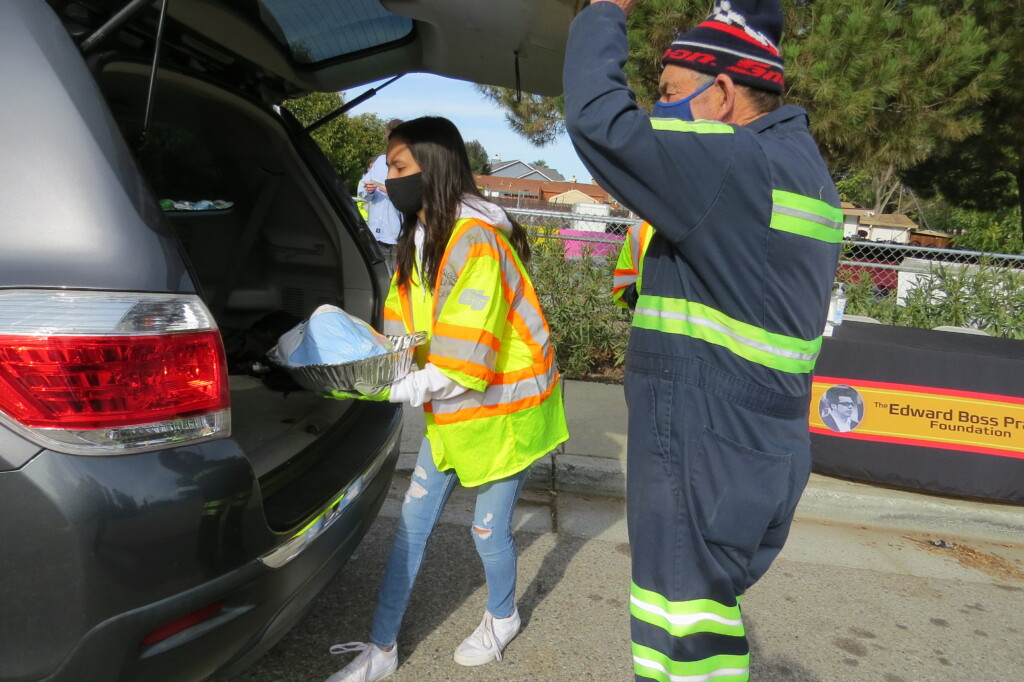
Live Oak High School Interact Club member Monica Iboa loads a frozen turkey with help from Gary Ponzini.
Photo by Marty Cheek
By Marty Cheek
As the COVID-19 crisis grows worse, men, women, and children in the South Valley face challenges getting adequate nutrition for their daily diet. Several nonprofit organizations distribute food and other necessities to help them throughout the year. Among them is the Edward Boss Prado Foundation, which has several programs that administers to local people who require assistance.
The foundation’s Cecelia’s Closet program is a distribution site located in the Madrone district north of downtown Morgan Hill. On Saturday Nov. 21, a steady stream of vehicles stopped by a curbside pop-up tent to pick up Thanksgiving turkey dinners at the location. Between 15 and 20 pounds, the frozen birds provide enough leftover meat for sandwiches and other meals for several days. The turkeys came with the traditional trimmings: mashed potatoes, gravy, stuffing, yams, cranberry sauce, cans of corn and cans of green beans.
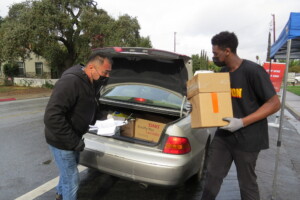 Five volunteers from the Live Oak High School Rotary Interact service club carried the items to the vehicles and placed them in the trunk or back seat. The volunteers were junior Monica Iboa, and seniors Shasta Hubbard, Saige Hubbard, and Katelin Pfeil. Interact member Faris Zulhazmi, a senior, patrolled the street with a red flag to guide the arriving vehicles.
Saige Hubbard said she joined the club to do community service. Seeing the people in need come to pick up their Thanksgiving meals helps her appreciate the blessings of her own life more.
“I really like volunteering, but I’m really sad COVID is happening because we don’t get to do volunteering very much,” she said.
Cecelia Ponzini, the founder of the Edward Boss Prado Foundation, expected about 500 families would enjoy a meal Thanksgiving Day through her group’s food distribution activities. The nonprofit gave turkeys to about 160 families that come to the Cecelia Closet site. The rest of the meals were distributed through other groups including Youth Alliance, Community Agency for Resources, Advocacy and Services, Rebekah Children’s Services, Community Solutions and the Morgan Hill Unified School District’s adult education program.
“The need is more because of COVID,” Ponzini said. “This isn’t just about the people who were already underserved. This is about people who had jobs and were doing well and are not doing well anymore and they’re worried about where their next paycheck is going to come from.”
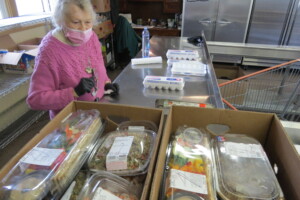 Families who have never sought assistance before have been coming to pick up food from Cecelia’s Closet in recent weeks. They include people who in the past have donated financially to the foundation. One man who stopped by is employed by a prominent Silicon Valley company and was forced to work at home because of COVID.
“We will continue to serve these families as long as I’m breathing,” Ponzini vowed. “The community has been really generous.”
The pandemic has changed how people interact, how they shop, and how they work. In some cases, those changes are relatively small such as wearing masks in public, working from home if they can, and trading in-person family gatherings for virtual game nights. But for food banks, pantries, meal programs and the people who depend on them, COVID-19 has meant a tremendous shift in not only a rising need, but how those programs such as St. Joseph’s Family Center in Gilroy and Cecelia’s Closet are operating.
The crisis has created a “new normal” that is likely here to stay, some experts say. And the challenges it brings with food insecurity will no doubt grow more severe over time in the South Valley as well as most of the United States.
 About 60 percent of Americans experience food insecurity since the expiration of federal assistance programs, such as enhanced unemployment benefits and stimulus payments. About half of those surveyed said they are struggling to provide their families with food more now than in the first months of the pandemic.
Programs run by the U.S. government help those in need. These include the Supplemental Nutrition Assistance Program, the Special Supplemental Nutrition Program for Women, Infants and Children, and the Emergency Food Assistance Program. Food banks such as Second Harvest and pantries such as St. Joseph’s in Gilroy, Cecelia’s Closet and the Reach Out emergency food distribution run by St. Catherine Church in Morgan Hill are picking up a lot of the slack locally.
The South Valley community has been extremely supportive in filling the food needs of local individuals and families who are struggling, said David Cox, executive director at St. Joseph’s. Several days of the week, the pantry’s staff start their days at 6:30 a.m. by driving a refrigerated truck until 2 p.m., making their rounds of pickups of food items that might otherwise be discarded from local retailers in Morgan Hill and Gilroy. These include Target, Walmart, Costco, Safeway, Trader Joe’s, Nob Hill, and Grocery Outlet. Rocca’s Market in San Martin helped ease the demand by supplying 200 Thanksgiving turkeys to St. Joseph’s.
 Years ago, the food pantries reception of food from retailers was very limited because of concerns of lawsuits if perishable food was spoiled and given to the needy. But Good Samaritan laws passed by California legislators have allowed stores and other suppliers to provide a higher quality and more variety of the products they donate, Cox said.
“Most of them are fresh items and nutritious items,” he said. “Luckily, we have the bandwidth to not only clean it and store it but make sure we’re keeping that cold chain in place.”
Through the funding of grants as well as private support, St. Joseph’s is able to make sure there is an adequate amount of food for those in need in the South Valley. The Sobrato Family Foundation, the Silicon Valley Community Foundation and the Khan Family Foundation philanthropy groups have been generous in helping fill the need, Cox said.
“I think one of the blessings for us is the diversity of the funding,” he said. “It’s been a challenge, but somehow we’ve been able to keep things sustained. It’s the diversity and the organic support that keeps us thriving.”


