

First needs are to weatherproof and keep wildlife out of 19th century structure
Published in the September 21 – October 4, 2016 issue of Gilroy Life
By Staff Report
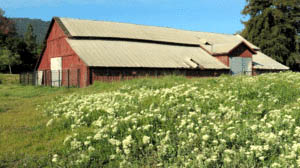
Photo courtesy Miller Red Barn Association
Gilroyans are passionate about their farm country history — and that includes support for restoring the “Red Barn” on the ranch side of Christmas Hill Park. Built by 19th century rancher Henry Miller, famous as “the Cattle King of California,” the barn received full support from California’s State Historical Resources Commission July 29, putting it potentially one day on the National Historic Registry list.
The group forming the nonprofit Miller Red Barn Association will hold a restoration benefit dinner Saturday Sept. 24. Gilroy Life spoke with Richard Perino, one of the members of the group working to give Gilroy a “barn again” experience and save the structure.
What exactly is the Henry Miller Red Barn and why is it important for the community to preserve it as a structure?
The barn was constructed in 1891 to process large quantities of tree fruit. While other crops like hay and grain were grown, farms had largely become deciduous tree fruit ranches. Miller gradually converted his property from pasture to fruit when he no longer needed to rest cattle on the way to the San Francisco slaughter house.
The barn represents in a larger form the many smaller, disappearing barns used over the years by the fruit rancher in South County. Fruit ranching was the staple business here from the 1880s until after World War II, and the facts of its existence are part of the underlying values here of respect for the land and its production that occasionally still surface. The barn is the witness to all that.
Briefly, describe the importance of the barn’s ranching history to the Gilroy region.
It makes no sense to talk about the barn if one doesn’t know about Henry Miller. He was a butcher’s boy who made it big as a land and cattle baron. Miller and his partner, Charles Lux, owned millions of acres of land in California, Oregon and Nevada. In the 1860s and early 1870s, Miller purchased the Las Animas Rancho, upon which Gilroy now sits. He called it the Bloomfield Farm and made his home base there at the foot of the pass into the San Joaquin Valley. When he no longer needed to rest cattle being driven to the slaughter house at the portion of the rancho he called “the Glen,” he began to experiment with growing fruit. Before he was through he had planted trees right up to Hanna Street four blocks from downtown. Hence, the Miller Red Barn in 1891.
What might the Red Barn be used for as a benefit to the public?
The intention is to use the barn for a wide variety of agricultural and environmental activities. Some of those could be exhibits, lectures, demonstrations, 4-H and FFA activities, historical presentations, dances, concerts, small theater, meetings — anything appropriate that the creative mind can come up with. The building does have to be brought to a minimum standard. This will be done in a step-by-step way. Currently, the Barn Association is raising money to weatherproof the building, and to prevent wildlife from entering.
Why is this important for your group for the Miller Red Barn to receive designation on the National Historic Registry?
The designation as a registered State and National Historic property gives the barn dignity — and deservedly so. It also give the barn a kind of respect that will be conducive to its protection. The designations also provide justification for raising money to preserve it. The process of fundraising will proceed as the assessment calls for dollars one need at a time. It is felt that to get it done right, it must be done carefully and to a standard that not only stands the test of time, but does not compromise the historic nature of the building.


