
Women’s History Month celebrated with tours of downtown homes

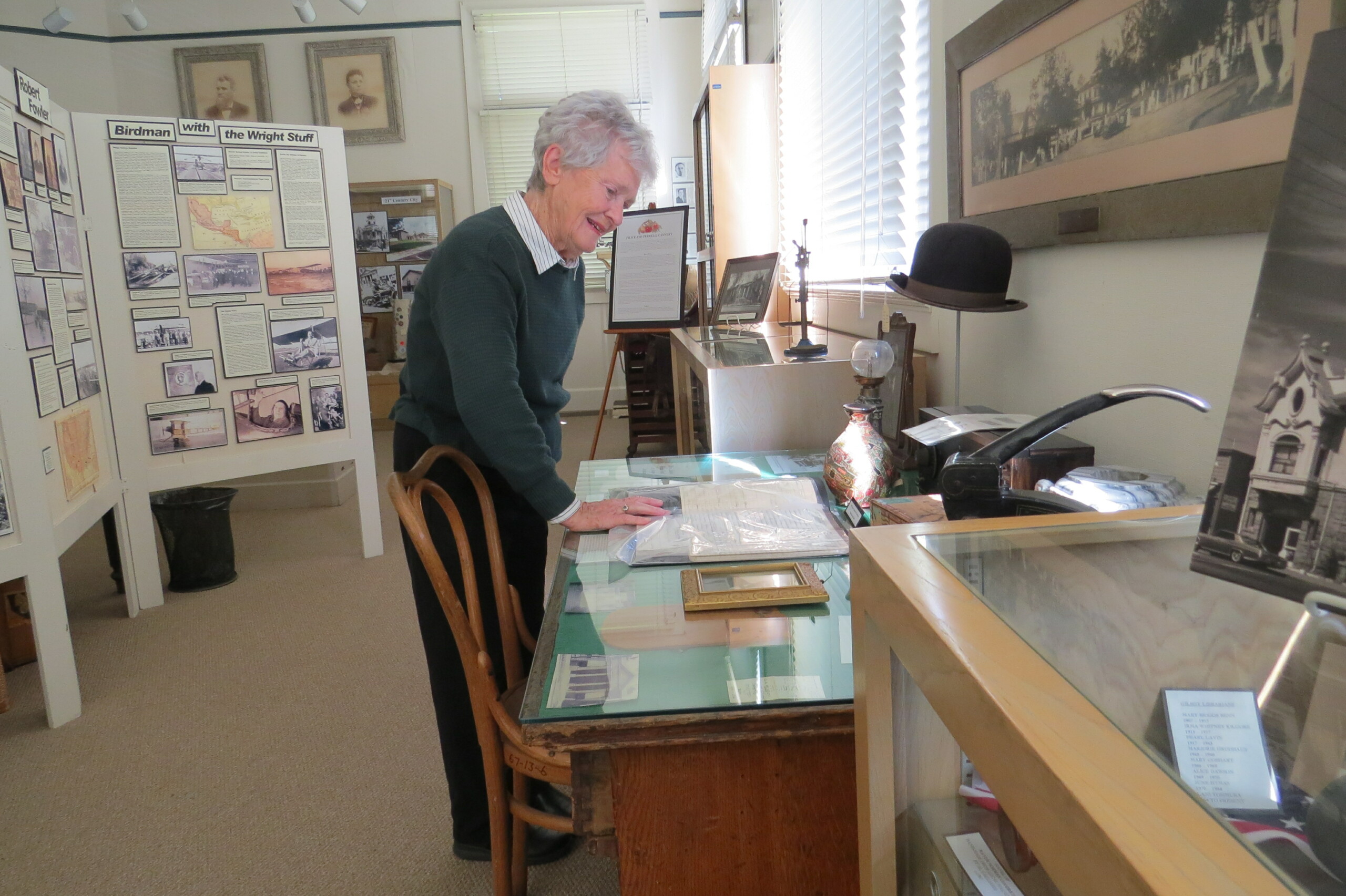
Gilroy Historical Society board president Connie Rogers shows an exhibit in the Gilroy Museum. She will be leading a March 4 history tour focusing on Gilroy’s prominent women leaders of the past. Photo by Marty Cheek
By Calvin Nuttall
 Downtown Gilroy is full of homes and businesses that stand testament to the lasting impacts of prominent women from the city’s history. To celebrate Women’s History Month, the Gilroy Historical Society will lead a two-hour walking tour of these landmarks March 4 to share the lives and legacies of the women behind them.
“We definitely had women in Gilroy who were ahead of their time,” said the society’s board president Connie Rogers, who leads the monthly walks program. “They were leaders and did important things that contributed to the culture of the community.”
The tour starts at 10 a.m. from the Gilroy Museum at the corner of Church and Fifth streets. It explores the Willey Cultural Center across the street. This is the former home of Judge Howard Willey, one of the city’s first justices, but the tour will focus on the lives of his daughters, Grace and Minnie, who lived there together for many years.
“They were very musically accomplished,” Rogers said. “They gave music lessons and hosted musical soirees at their home. They were ahead of their time as women who supported themselves with an occupation.”
Not far down Fifth Street is a house Rogers described as one of her favorite places. It is the former residence of Caroline Hoxett, who moved there in 1868 with her husband, Samuel Osbourne. The home also happens to be the current residence of Roberta Hughan, who was the first woman mayor of Gilroy as well as the first woman council member. Osbourne died in the late 1880s, leaving Hoxett $40,000.
“That was a lot of money in those days,” Rogers said. “And she did really good things with it. She invested it in the community.”
Hoxett conducted much of her charitable work as president of the California Rebekah Assembly, which she was elected to in the 1890s. The Rebekahs are a sororal organization established in the 1890s to promote charity.
“Fraternal organizations were very popular in those days,” Rogers said. “That was Gilroy’s social life. Before advanced transportation, TV, and cell phones, people had their clubs and fraternal organizations. These organizations were kind of a mutual aid support group.”
When the Rebekahs decided to build an orphanage in Gilroy, Hoxett knew just where to put it. She chose the site in 1897 for the first Rebekah’s Children’s Home. The structure was rebuilt in the 1920s to make it safer from fire and earthquakes. The “new” building, designed by famous architect William Weeks, is itself now more than 100 years old and now serves as the headquarters for Rebekah’s Children’s Services.
“They still take care of children there,” Rogers said. “And there are still Rebekah members on the board of directors. It is no longer an orphanage, but they provide services at homes and schools throughout the area, as well as housing for dependents of the court. Caroline Hoxett chose the site, and I think it was a good one because Gilroy is centrally located.”
In the early 1900s, Hoxett also got the ball rolling on another major Gilroy landmark. By purchasing a tennis court and giving it to the city, she helped the community qualify for the Carnegie Grant, a fund given by steel baron Andrew Carnegie for the construction of public libraries. This brought in $10,000 to fund the construction of the Carnegie Library on the donated lot. The library was built in 1910 and moved to its current location in 1975 where it now serves as the Gilroy Museum.
Moving on from Hoxett’s home, the tour passes the former location of the home of indigenous woman leader Maria Ascención Solórsano.. Well known in the community as a curandera, a folk healer, she was also the last living fluent speaker of the Amah Mut sun language.
“She was definitely famous,” Rogers said. “A man from the Smithsonian came and interviewed her extensively in her final years, recording the language. People would also come to her when they had illnesses, and she would give them herbal remedies. She grew a lot of herbs in her garden.”
Solórsano died in 1930. Her recordings remain an object of study as the Amah Mutsun tribe works to revitalize the dead language. In the 1970s, this source material was also used by linguistics researcher Marc Okrand as inspiration for the language of the Klingons, an alien race from the “Star Trek” series.
From there, the walk goes up Hanna Street to the block across from Brownell Middle School where the next stop is a two-story white house that operated as a maternity home from 1920 to 1940. The business was run by a woman named Mildred Quale.
“She delivered more than 200 babies there,” Rogers said. “Gilroy didn’t have a hospital until 1929. At the museum we are very fortunate to have the logbook from the maternity home, which lists all of the babies that were born there.”
During the tour, Rogers also touches on the stories of several women whose homes are no longer standing, but who nonetheless made long-standing impacts in the community. These include Mary Briggs Benn, the first librarian; Catherine Ryan, a postmistress who filled the role after her husband, the previous postmaster, died; and Clara Silvia, a doctor who lived where the post office now stands.
 Rogers herself has made major impacts in the community. A city councilwoman from 1993 to 1997, she became mayor of Gilroy for a month when a vacancy opened in March 1997.
“We had to decide whether we want to appoint somebody, or wait until the November election,” she said. “We decided the fairest thing to do would be to wait for the election, and so we each took turns being mayor for a month.”
Emphasizing the contributions of women is vital for presenting a balanced viewpoint of history, Rogers said. She invites parents to bring their children to see local examples of how women can and have been leaders in the community. She also encourages both long-time Gilroy residents and newcomers to attend the monthly history walks.
“It’s a great way of getting acquainted with the community,” Rogers said. “And Gilroy natives often have interesting info to add, and I learn from them.”
Calvin Nuttall is a Morgan Hill resident and freelance reporter for Gilroy Life.