

Gilroy Mariachi Academy musicians performed
Published in the September 21 – October 4, 2016 issue of Gilroy Life
By Marty Cheek
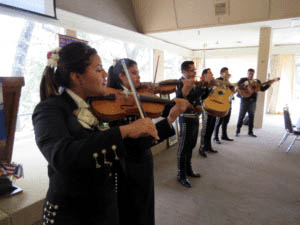
Photo by Marty Cheek Musicians from the Gilroy Mariachi Academy perform at a Gilroy Rotary Club meeting where Gilroy Rotarians celebrated the kickoff of National Hispanic Heritage Month.
National Hispanic Heritage Month is held annually from Sept. 15 to Oct. 15. The Gilroy Rotary Club decided to kick it off a couple of days early with traditional mariachi music, a meal of Mexican dishes and a short lesson on the many Hispanic leaders and cultural figures who have contributed to the American story.
The centerpiece of the celebration at the club’s Sept. 13 meeting was a group of musicians from the Gilroy Mariachi Academy performing a set of beloved Mexican songs to the enjoyment of the Rotarians and their guests.
“What mariachi is is a way for musicians to show various ways of expressions,” said Jorge Rodriquez, an instructor at the academy. “They use a lot of metaphors and personifications to relate certain moments that they have gone through in life. Mariachis is pretty poetic. A lot of the composers when they wrote the music, they did it from the heart. And a lot of mariachis are very versatile in what they compose in their music.”
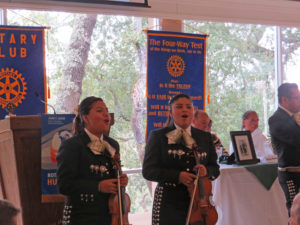
Photo by Marty Cheek
Sisters and Santa Clara University students Moriah and Geraldine Montez, who both play the violin with the Gilroy Mariachi Academy, sang a romantic mariachi ballad at the Gilroy Rotary Club meeting.
Sisters and fellow Santa Clara University students Geraldine and Moriah Montez, who both play the violin at the academy, took time during the performance to sing a romantic mariachi ballad.
“I started violin when I was 3 but I started classical training,” Geraldine said. “And I joined mariachi about 10 or 12 years ago. I really like mariachi because it’s a different form of discipline.”
Mariachi has been around for hundreds of years and is a proud part of the Mexican culture that strengthens the family through music by helping children embrace the culture they are part of, she said.
Father Jose Rubio of St. Mary’s Parish in Gilroy gave a short talk to the Rotarians about the contributions of Hispanic men and women throughout America and the impact they have had in shaping the nation’s culture.
Among them, he discussed Bernardo de Gálvez y Madrid, Count of Gálvez, for whom the city of Galveston, Texas, was named. A Spanish general, he helped the colonial forces during the American Revolution defeat the British forces, including the conquest of the British towns of Mobile and Pensacola in the province of West Florida.
“The loss of Mobile and Pensacola left the British with no bases at all along the Gulf Coast,” Rubio said.
September was chosen as the start of National Hispanic Heritage Month because eight of the 20 republics in Latin America announced their independence that month, he said. Mexico celebrates its independence day Sept. 16.
Locally, Latinos have contributed to American society in the judicial field, medicine, sports, literature, arts, academics and others, he said. The Hispanic culture contributes to the rich tapestry of the diversity of America, he said.
“We are a better community because of the Mexicans, Croatians, Indians, Filipinos, Italians, Japanese, African-Americans, Egyptians, Pakistanis, because we are Hindus, Protestants, Catholics, Jews, Muslims, Buddhists and Sikhs,” he said. “We are a better community because of this variety that we have here, and we need to preserve the variety because it makes us all better people. So this month we celebrate Hispanic Heritage Month, and we celebrate the accomplishments of people of Hispanic heritage. But we also need to celebrate the accomplishments of everyone, because in our diversity and in our variety, we all become better people.”
Rachel Perez, a Gilroy Rotary Club member, said she takes pride in her culture and that was one of the reasons she worked with fellow club member Jaime Rosso to organize the special event. Celebrating the Hispanic heritage puts a spotlight on many of the accomplishments of Latino-American citizens, she said.
“To me, I think a lot of our accomplishments have gone unrecognized because it’s in the shadow of some of these others things, such as this whole immigration debate,” she said. “So I think the message gets buried. But actually we contribute a lot to our America’s culture, and sometimes that doesn’t get publicized and promoted as well.”
The celebration was initiated in a request by Marco Renella, the Rotary club president, Rosso said. Many Rotary clubs have an issue with its membership not fully representing the demographics of the communities they serve, he said.
“Part of what he has talked about in preparing to be president, he talked about the importance of diversity that Rotary International (promotes),” Rosso said. “The big push in Rotary is to get people in who are more indicative of the community in which they serve.”


